 English (US) ▾
 Nederlands
 English (UK)
 Deutsch
 Italiano
 Português
 Español
 Français
Childcare & Community Development Volunteering Abroad: Costs, Ethics and How to Choose
Blog · August 17, 2026 · 11 min read · By Luni
Childcare and community development volunteering abroad means supporting children and families through day centers, kindergartens, after-school clubs and community projects — not living in or running an institution. With Volunteering Solutions it starts at US$285 for a week in Nepal and runs to around $1,745 for three weeks in Ireland, with most Asian and African placements landing between $285 and $650. The part almost nobody explains honestly is the ethics: working with children carries real safeguarding obligations, and the type of placement you choose matters far more than the country.
This guide covers what the work actually involves, what every placement costs, how community development differs from childcare, and the specific questions to ask before you book anything that puts you in a room with a child.
What is childcare volunteering abroad?
Childcare volunteering abroad is unpaid, supervised support work in early-years and community settings overseas — day care centers, kindergartens, nurseries, after-school clubs, feeding centers and youth programs. Volunteers assist local staff with play, basic literacy, meals and creative activities. It is short-term supplementary help, not a substitute for qualified caregivers or teachers.
That definition matters because “volunteering with children” gets used loosely online to cover everything from a kindergarten teaching assistant role to a residential childcare center placement. Those are very different things, and only one of them is broadly considered good practice. We get to that below.
What does a childcare volunteer actually do day to day?
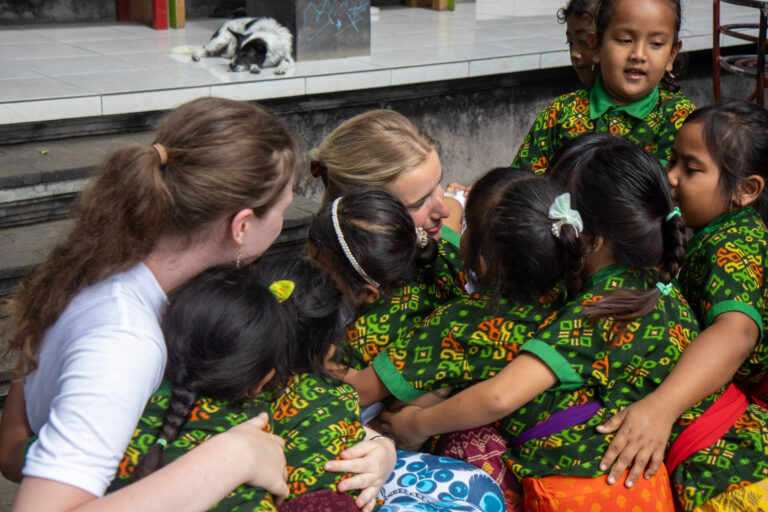
The honest answer: you are an extra pair of hands for people who are short of them. A typical day at our early-years childcare program in Kathmandu runs 10am to 3pm and involves playing with children aged three to six, singing, storytelling, crafts, helping at mealtimes, toilet training and introducing English letters and numbers.
Across our other placements the pattern is similar, with local variations:
- Kindergartens and nurseries — classroom assistance, structured play, early literacy and numeracy. This is the bulk of the Bali kindergarten program and the Rabat day-center placements in Morocco.
- After-school and non-formal education centers — homework support, games, arts and music. The street children program in Delhi works largely this way, at shelters and education centers serving slum communities.
- Community childcare and youth support — a blend of early-years work, homework help and family-focused parenting support, as at our Port Elizabeth program in South Africa.
- Day care with practical support duties — helping prepare meals, assisting staff with admin, and supporting fundraising, as at the Arusha childcare program in Tanzania.
What you will not do: make care decisions, be left alone in charge, deliver a formal curriculum, or take on anything a qualified professional should be doing. If a program promises you that kind of responsibility with no relevant qualification, that is a warning sign rather than a selling point.
How much does childcare volunteering abroad cost?
Below is every childcare placement in our current catalogue with its real starting price and minimum stay. Prices are in US dollars and cover the program fee — typically accommodation, meals as specified, airport pickup, orientation and in-country support — but not flights, visas or insurance. Always check the individual program page for current pricing, since fees and inclusions change.
| Country / city | Placement | From (USD) | Minimum stay |
|---|---|---|---|
| Nepal — Kathmandu | Early years childcare support | $285 | 1 week |
| India — Delhi | Street children program | $301 | 1 week |
| Tanzania — Arusha | Childcare | $325 | 1 week |
| India — Jaipur | Childcare at shelter homes | $350 | 1 week |
| Kenya — Nairobi | Childcare | $350 | 1 week |
| South Africa — Cape Town | Childcare & social welfare | $404 | 1 week |
| Morocco — Rabat | Day centers & nurseries | $440 | 1 week |
| Bali | Kindergarten | $470 | 1 week |
| Peru — Cusco | Day care center | $495 | 1 week |
| South Africa — Port Elizabeth | Community childcare & youth support | $529 | 1 week |
| Ghana | Kindergarten & teaching | $550 | 2 weeks |
| Vietnam — Ho Chi Minh City | Childcare | $560 | 2 weeks |
| Cambodia | Childcare | $570 | 2 weeks |
| Sri Lanka | Kindergarten | $625 | 1 week |
| Vietnam — Hanoi | Childcare | $657 | 2 weeks |
| Philippines | Childcare & social welfare | $890 | 2 weeks |
| Ecuador — Quito | Children & community | $901 | 3 weeks |
| Costa Rica | Childcare | $1,014 | 2 weeks |
| Argentina | Socio-educational center | $1,650 | 4 weeks |
The pattern is consistent across the sector: South Asia and East Africa are cheapest, Latin America sits in the middle, and Europe is the most expensive because local living costs are higher. If budget is your main constraint, our guide to volunteering abroad for free does the arithmetic on the genuinely fee-free routes and where they do and don’t work out cheaper.
How is community development volunteering different?
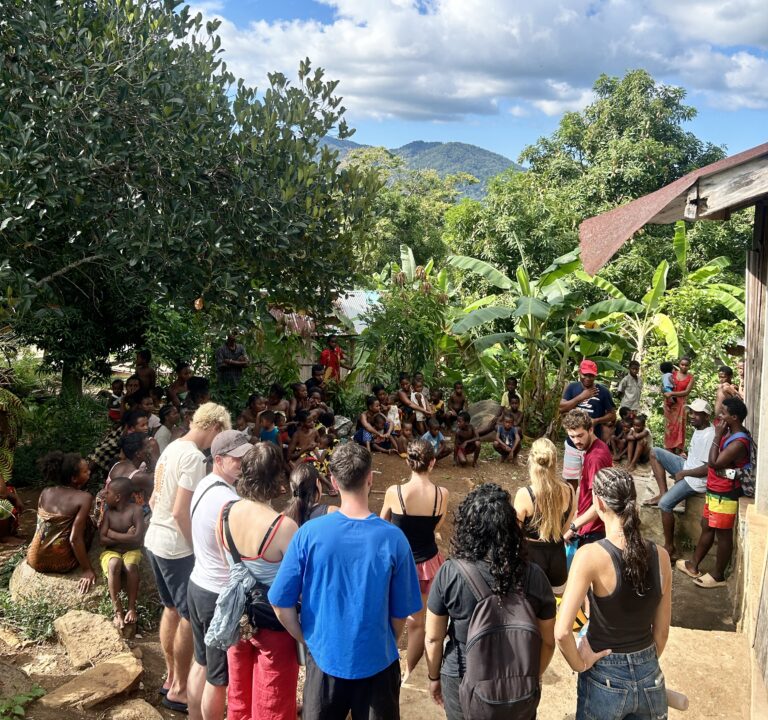
Community development volunteering works with a whole community rather than with children specifically — supporting a local NGO, running workshops, improving physical infrastructure, or helping with food security and health outreach. It is often the better choice if you want to contribute without the safeguarding complexity of working directly with under-18s, or if you have a professional skill to bring.
| Country | Project | From (USD) | Minimum stay |
|---|---|---|---|
| India — Jaipur | Construction & renovation | $350 | 1 week |
| South Africa — Port Elizabeth | Community childcare & youth support | $529 | 1 week |
| Madagascar | Community development | $620 | 2 weeks |
| Spain — Barcelona | Community development | $713 | 1 week |
| Philippines | Public health & nutrition | $890 | 2 weeks |
| Cambodia | NGO support | $970 | 5 weeks |
| Portugal — Porto | Community support, youth support or food-waste management | $1,043 | 1 week |
| Ireland | Community development, charity shop or arts projects | $1,745 | 3 weeks |
Related routes worth comparing before you commit: women’s empowerment, teaching, sports coaching, special needs care and construction and building projects.
Is it ethical to volunteer with children abroad?
It can be, and it depends almost entirely on the setting. The area where the evidence is unambiguous is residential childcare center volunteering, and it is worth being blunt about it.
Child-protection organizations estimate that at least 80% of children living in childcare centers have at least one living parent. Institutional care is associated with measurable developmental harm, and a steady flow of paying foreign visitors creates a financial incentive to keep children in institutions rather than reunify them with families. A rotating cast of volunteers who bond with a child and then leave compounds the problem. Short residential-childcare center placements are the one part of this sector that a well-run organization should be steering people away from.
What this means in practice when you are choosing:
- Prefer day-based placements. Kindergartens, day care centers, after-school clubs, community centers and feeding centers let a child go home to their family at the end of the day. Most of our childcare catalogue works this way.
- Be honest about the exceptions. A minority of placements in our catalogue — and in every provider’s catalogue — operate at children’s homes or shelters that provide residential care for children who genuinely have nowhere else to go, such as the shelter homes in the Jaipur program. If you are considering one of those, ask who the children are, why they are there, what the reunification plan is, and what the minimum volunteer stay is. Longer stays are better; a few days is not.
- Watch for anything that treats children as the attraction. Programs that advertise performances for visitors, unrestricted photography, or “cuddle time” as a selling point are running a tourism product, not a care service.
None of this means childcare volunteering is inherently exploitative. A day center in Rabat or a kindergarten in Bali that is short of adult hands genuinely benefits from an extra person who shows up reliably for two weeks. The failure mode is specific, and it is avoidable.
What safeguarding rules should a program actually have?
This is the most useful due-diligence test available to you, because it is answerable in one email. Ask a provider for their child protection policy and read it. If they cannot produce one, that is your answer.
Our own Child & Vulnerable Adult Protection Policy and Safeguarding Policy are published in full, and the operative rules are specific rather than aspirational:
- No child or vulnerable adult may be taken outside the placement site without prior permission from the organization.
- Volunteers may never take a child to their homestay, guesthouse, hotel or accommodation.
- Permission must be taken before any photos or videos are captured.
- Volunteers must not use physical force that could cause fear, intimidation or distress.
- Every volunteer receives a detailed code of conduct during in-country orientation.
- We run a DBS check on all participants, and anyone who does not clear it is not admitted to any of our projects.
The individual program pages carry the same requirement in plain terms: participants must have no criminal convictions and must provide a clean criminal background check report. A provider that places strangers with children without checking either of those things is not one you want to hand money to — and yes, that is a real and common gap in this industry.
What do you need to join a childcare program?
For most of our placements the requirements are modest and deliberately so:
- Minimum age 17 or 18, depending on the placement. Nepal and Bali accept volunteers from 17; Jaipur and Rabat require 18. Each program page states its own age rule, and under-18s traveling in organized groups are handled through our teen and high-school programs.
- A clean criminal background check — arrange this early, as UK DBS and equivalent checks can take several weeks.
- No formal childcare qualification for assistant roles, though experience with children helps and is welcome.
- Conversational English; Spanish is genuinely useful in Peru, Ecuador, Argentina and Costa Rica, and French helps in Morocco and Madagascar.
- Travel insurance and a valid visa — requirements vary by country and are set out on each destination page.
How long should you stay?
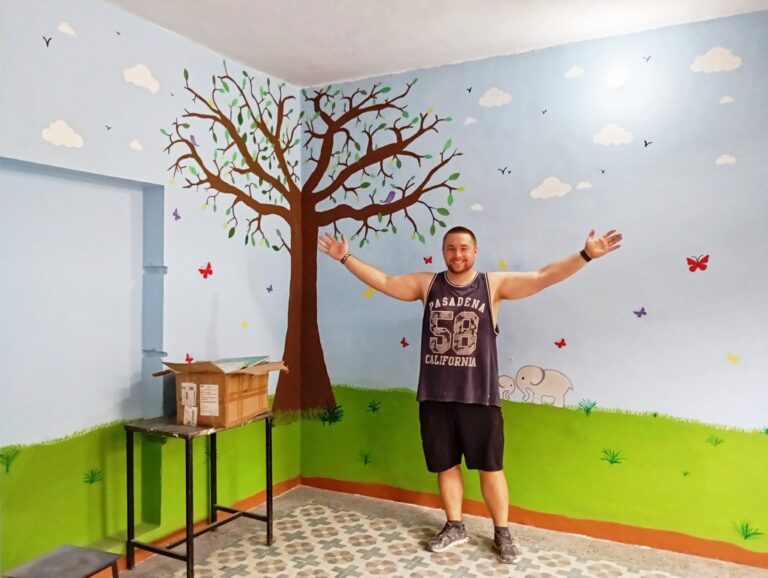
Several of our childcare placements accept one-week stays, and there is a legitimate case for them: a short, well-supervised assistant role at a day center is genuinely useful, and one week is what many people can actually afford. But be realistic about what a week achieves. Two to four weeks is the point at which you stop being an orientation task for local staff and start being useful to them, and it is also the point at which children get some continuity rather than another face that appears and disappears.
If you can only manage a week, spend it at a day placement rather than a residential one. The argument against very short stays is strongest precisely where the children are most vulnerable.
Green flags and red flags
Green flags: a published child protection policy; a mandatory background check; day-based placements; local staff leading the work with volunteers assisting; clear minimum stays; transparent pricing that says where the money goes; and independently verified reviews. We are a certified B Corporation operating since 2007 with in-country teams in every destination, and our responsible volunteer travel policy sets out the standard we hold ourselves to.
Red flags: no background check requested; residential childcare center placements marketed as the highlight; “no experience or checks needed, start tomorrow”; children performing for visitors; photography with no restrictions; vague pricing with no breakdown; and any provider that cannot tell you who runs the project on the ground.
Frequently asked questions
How much does it cost to volunteer with children abroad?
With Volunteering Solutions, childcare placements start at US$285 for one week in Nepal, $301 in Delhi, $325 in Tanzania and $350 in Kenya and Jaipur. European and Latin American placements cost more — Costa Rica from $1,014 for two weeks and Ireland from $1,745 for three. The fee typically covers accommodation, meals as specified, airport pickup, orientation and 24/7 in-country support, but not flights, visas or insurance.
Do I need a qualification or a background check?
You do not need a childcare qualification for assistant roles, but you do need a clean criminal background check. We run a DBS check on every participant and do not admit anyone who does not clear it. Apply for your check early, as processing can take several weeks.
Is childcare center volunteering ethical?
Short residential childcare center placements are widely discouraged by child-protection organizations. An estimated 80% or more of children in childcare centers have at least one living parent, institutional care is linked to developmental harm, and paying volunteers can create an incentive to keep children institutionalised. Day-based placements — kindergartens, day care centers and after-school clubs, where children return to their families each evening — avoid these problems.
What is the minimum time I can volunteer with children?
Several placements accept one week, including Nepal, Delhi, Tanzania, Kenya, Jaipur, Cape Town, Rabat, Bali, Cusco, Port Elizabeth and Sri Lanka. Two to four weeks is more useful for both you and the project, and longer stays are strongly preferable for any placement involving residential care.
What is the difference between childcare and community development volunteering?
Childcare volunteering supports children directly in early-years and education settings. Community development volunteering supports a whole community — NGO support, construction and renovation, food security, health outreach or youth work — and usually involves fewer safeguarding requirements. Some programs, such as our Port Elizabeth placement in South Africa, combine both.
How old do you have to be to volunteer with children abroad?
It depends on the placement: our Nepal and Bali childcare programs accept volunteers from 17, while Jaipur and Rabat require 18. Every program page states its own minimum age. Under-18s traveling in organized groups go through our teen and high-school programs, and school or university groups are arranged separately through our group and faculty-led trips.
Where to go next
Browse the full childcare volunteer abroad programs and community development projects, or start from a country: Nepal, Kenya, Tanzania, Morocco, Madagascar or Cambodia. If you are weighing up value, our roundup of the most affordable volunteer abroad programs and our pieces on ways to volunteer abroad with children and volunteering with children in South Africa are good next reads. Still narrowing it down? Get in touch and we will talk you through the options.

Luni Chhochoon writes for Volunteering Solutions, a certified B Corporation, covering volunteer abroad programs, destinations and tips for traveling with purpose.