 English (US) ▾
 Nederlands
 English (UK)
 Deutsch
 Italiano
 Português
 Español
Volunteer Teaching Abroad: Costs, Requirements and How to Choose a Program
Blog · August 17, 2026 · 11 min read · By Sahil
Volunteer teaching abroad means joining a school or community education project overseas as an extra pair of hands — usually supporting English lessons alongside a local teacher. Most programs ask for fluent English and enthusiasm rather than a degree or a TEFL certificate. With Volunteering Solutions, teaching placements start from US$285 for a week in Nepal and run in 17 countries, with minimum stays of one or two weeks depending on the destination.
This guide covers what the work actually involves, what it costs country by country, the school-holiday dates that catch people out, and how to tell an honest teaching program from a badly designed one. Prices quoted here are the current starting prices — always check the program page for live pricing before you book.
What is volunteer teaching abroad?
Volunteer teaching abroad is a short-term placement in an overseas school, kindergarten or community learning center where you help deliver lessons — most often conversational English — under the direction of local staff. Placements typically run one to twelve weeks, are open to people without teaching qualifications, and are paid for by the volunteer rather than salaried.
It is the most common form of volunteering abroad, and also the one most often done badly. The difference between a placement that genuinely helps and one that simply feels good comes down to a few structural things: whether there is a qualified local teacher in the room, whether the school asked for volunteers in the first place, and whether the timetable survives after you leave. Those are the things this guide helps you check.
If you want the full catalogue rather than the explainer, our teaching volunteer projects abroad hub lists every current placement with live pricing and start dates.
Do you need a degree or a TEFL certificate to volunteer teach abroad?
For volunteer teaching, no. Paid English teaching jobs in most countries require a bachelor’s degree plus a TEFL/TESOL certificate because they need a work visa; volunteer placements sit on a different footing. On our Nepal teaching program, for example, the stated requirement is simply good spoken English and genuine enthusiasm for working with children.
That said, a TEFL certificate changes what you can do once you arrive. Without one you will usually be assisting: running conversation practice, small-group drills, games and pronunciation work. With one — or with prior classroom experience — schools are far more likely to hand you a class of your own and a slot on the timetable. Neither is better; they are different jobs. Be honest with your coordinator about which you are, because a school planning around a teacher who turns out to need supervision is worse off than one that expected an assistant.
What every placement does require: patience, punctuality, and a willingness to prepare. We cover the paid-work distinction in more detail in how to teach abroad without a degree.
What does a volunteer teacher actually do each day?
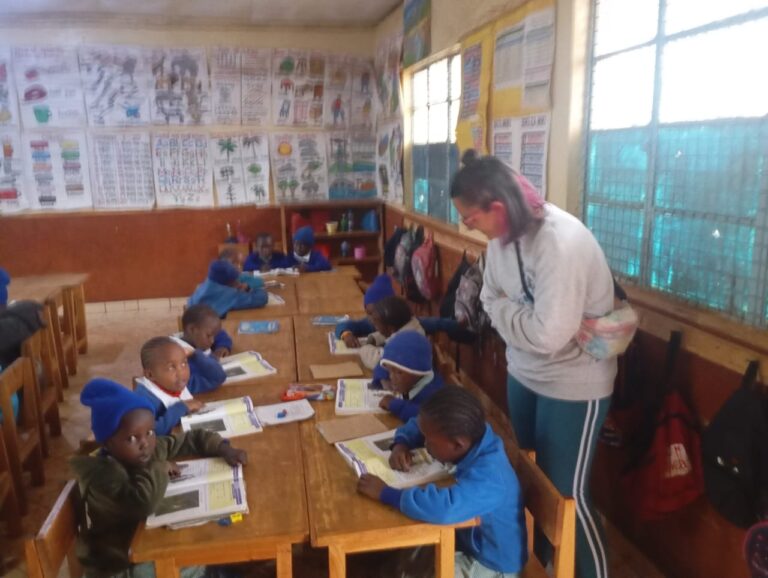
A typical weekday runs Monday to Friday, roughly 8am to 1pm, with afternoons and weekends free. You will usually be attached to one school for your whole stay so the children get continuity.
The work itself varies more than the marketing suggests. In Thailand, our Chiang Mai teaching placement puts volunteers into public schools of anywhere from 100 to 1,000 students, deliberately choosing schools with no foreign teachers on staff — the local English faculty are strong on grammar and mechanics, so what volunteers add is spoken fluency practice. In Kenya, volunteers assist across subjects — maths, science, geography, history, business studies, art and music, not only English. On the Jaipur teaching program and the linked slum education project, the emphasis is on non-formal methods — games, activities and interactive sessions — in government and NGO-run schools serving families below the poverty line.
Common tasks across all of them: planning and delivering simple lessons, one-to-one tutoring, homework and exam support, classroom management alongside local staff, and preparing materials. A few programs are explicitly early-years instead — the Ghana kindergarten placement and Sri Lanka kindergarten program among them. There is also a genuinely unusual option: teaching English to novice monks in Chiang Mai’s temple schools.
How much does volunteer teaching abroad cost?
Below is every current Volunteering Solutions teaching placement with its starting price and minimum stay. These are the real program fees, not indicative ranges.
| Destination | Program | From (USD) | Minimum stay |
|---|---|---|---|
| Nepal (Kathmandu) | Teaching in local schools | $285 | 1 week |
| Tanzania (Arusha) | Teaching | $325 | 1 week |
| India (Jaipur) | Teaching / slum education | $350 | 1 week |
| Kenya (Nairobi) | Teaching | $350 | 1 week |
| Morocco (Rabat) | Teaching English | $440 | 1 week |
| Bali | Teaching | $470 | 1 week |
| Peru (Cusco) | Teaching English | $495 | 2 weeks |
| South Africa (Cape Town) | Teaching | $525 | 2 weeks |
| Ghana | Kindergarten & teaching | $550 | 2 weeks |
| Cambodia | Teaching English | $570 | 2 weeks |
| Madagascar | English teaching | $620 | 2 weeks |
| Sri Lanka | Kindergarten & teaching | $625 | 1 week |
| Tanzania (Zanzibar) | Teaching | $625 | 1 week |
| Vietnam (Hanoi) | English teaching | $657 | 2 weeks |
| Thailand (Chiang Mai) | Teaching English | $790 | 2 weeks |
| Philippines | Teaching | $890 | 2 weeks |
| Costa Rica | Teaching English | $1,014 | 2 weeks |
Europe costs considerably more — education projects in Ireland start at $1,745 and Spain’s youth and education program in Valencia at $1,999, both reflecting European accommodation and living costs.
The fee covers your placement, accommodation and in-country support, with meals included on most (not all) programs — the exact inclusion list is on each program page. It does not cover flights, travel insurance, visas or vaccinations. Extra weeks are cheaper than the first: Nepal adds roughly $90–105 per additional week rather than another $285, which is why longer stays work out at a much better daily rate. If cost is the deciding factor, read our honest breakdown of how to volunteer abroad for free — including where fee-free routes genuinely beat a paid program and where they don’t — and our guide to university funding for volunteering abroad if you’re a student.
Which country should you choose?
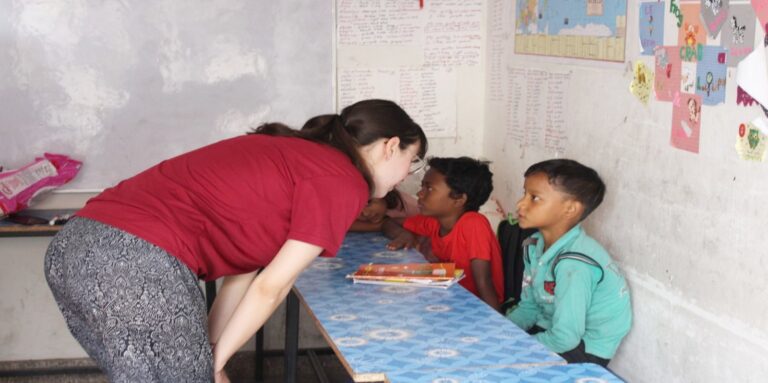
Four questions narrow it down fast.
How much can you spend? Nepal, Tanzania, India and Kenya are the affordable end and all accept one-week stays. Nepal at $285 is the lowest entry point we run anywhere.
How long have you got? If you only have a week, your options are Nepal, Tanzania (Arusha or Zanzibar), India, Kenya, Morocco, Bali and Sri Lanka. Everything else starts at two weeks. Our one-week programs and short-term placements hubs collect these across all causes.
Do you want a second language out of it? Peru and Costa Rica give you daily Spanish; Morocco runs on French in schools and administration (more useful there than Arabic); Vietnam, Cambodia and Thailand immerse you without expecting the language.
What kind of classroom? Large urban public schools (Thailand, Kenya), small community and NGO schools (India, Ghana), early-years settings (Sri Lanka, Ghana, Peru), or township schools (Cape Town). Our older roundup of the best countries for teaching volunteer programs goes deeper on the country-by-country feel.
When are schools actually open? The detail most guides skip
This is the single most common planning mistake: booking a teaching placement during the destination’s school holidays. Term dates abroad rarely line up with the northern-hemisphere summer, and a school on holiday cannot host a classroom volunteer. Here is what actually happens on our programs.
| Destination | School holidays | What happens to your placement |
|---|---|---|
| Kenya | April, August, late November to end of December | No teaching available — volunteers are placed in childcare and youth programs instead |
| South Africa (Cape Town) | South African school holidays | The teaching project closes; choose different dates or a different project |
| Tanzania (Arusha) | Term breaks | Volunteers have the option of working at children’s homes |
| Morocco (Rabat) | School holidays | Volunteers support English instruction at summer camps |
| Madagascar | School holidays | Summer classes run — a mix of English and science-based sessions |
| Everywhere else | Varies, and shifts year to year | Confirm term dates with your coordinator before booking flights |
Notice that four of those five have a real alternative rather than a cancellation — that is what an established in-country team is for. But you should still know which one you are getting before you pay for a flight. If a provider cannot tell you the school calendar for your dates, that is informative in itself.
Is volunteer teaching abroad ethical?

It can be, and it frequently isn’t. The honest position: an untrained visitor cannot replace a qualified teacher, and any program that implies otherwise is selling you a fantasy. What a volunteer can genuinely add is capacity a stretched school does not have — small-group attention, conversation practice with a fluent speaker, and materials and energy for activities the timetable can’t otherwise fit.
Green flags: a qualified local teacher stays in the room and directs the work; the school requested support rather than being recruited to receive it; you’re assisting a curriculum that continues after you leave; placements are day settings — schools, kindergartens, community centers — that children go home from; and the provider tells you plainly what the fee pays for.
Red flags: placements in residential childcare centers (we don’t run them, and the evidence against childcare center volunteering is now overwhelming); “teach your own class from day one, no experience needed”; no background check asked of you; a rotating cast of volunteers with no continuity; and vague answers about where the money goes.
Volunteering Solutions is a certified B Corporation and has been running programs since 2007, with in-country teams in every destination we operate. That doesn’t make us automatically the right choice — but it does mean the standards above are ones you can hold us to. More on how we work is on our about us page.
How long should you volunteer teach for?
Longer is better for the school, and the cost curve rewards it. A one-week placement is best understood as an introduction — useful if it’s genuinely all you have, and far better in a project designed around short stays than in one that isn’t. Two to four weeks is the sweet spot for most first-time volunteers: long enough to learn names, see progress and be useful, short enough to fit a holiday or a break between terms.
Beyond four weeks the marginal cost drops sharply and your usefulness climbs, which is why gap year volunteers often stay eight to twelve weeks. If teaching is one of several things you want to try, many volunteers combine it with childcare, community development or women’s empowerment work in the same country.
How do you choose a teaching program?
Six questions to ask any provider before you pay:
- Which school will I be in, and how many volunteers are there already? A named placement beats a category.
- Will a local teacher be present? If the answer is “you’ll have your own class”, ask why the school has no teacher for it.
- What are the term dates for my exact travel window? See the table above.
- What does the fee include, and what does it not? Get flights, insurance, visas and daily transport costed separately.
- Who do I call at 2am? There should be a named in-country person, not a head-office inbox in another time zone.
- What happens if my placement falls through? Every honest provider has had this happen. Ask what they did.
Frequently asked questions
Do I need a TEFL certificate to volunteer teach abroad?
No. Volunteering Solutions teaching placements require fluent spoken English and enthusiasm for working with children, not a TEFL certificate or a degree. A TEFL qualification is useful — it makes schools more likely to give you your own class rather than an assistant role — but it is not a condition of joining.
How much does it cost to volunteer teach abroad?
Volunteering Solutions teaching programs start from US$285 for one week in Nepal, $325 in Tanzania, $350 in India and Kenya, and $790 for two weeks in Thailand. The fee covers your placement, accommodation and in-country support, with meals included on most programs. Flights, insurance and visas are extra.
What is the shortest teaching placement I can do?
One week, available in Nepal, Tanzania (Arusha and Zanzibar), India, Kenya, Morocco, Bali and Sri Lanka. All other teaching destinations have a two-week minimum, and Ireland and Spain require longer.
Can I teach abroad without a degree?
Yes, as a volunteer. Paid English teaching jobs usually require a degree because of work-visa rules, but volunteer teaching placements do not — you travel on a tourist or volunteer visa and are not employed by the school.
What if the schools are on holiday when I travel?
It depends on the destination. In Kenya, teaching stops in April, August and from late November to the end of December, and volunteers move to childcare and youth programs. Tanzania offers children’s homes, Morocco runs summer camps and Madagascar runs holiday classes. In Cape Town the teaching project closes entirely during South African school holidays. Always confirm term dates before booking flights.
Is volunteer teaching abroad actually useful?
It is when the placement is structured properly: a qualified local teacher leads, the volunteer adds small-group attention and spoken-English practice, and the timetable continues after the volunteer leaves. It is not useful when an untrained volunteer replaces a teacher, when placements are residential childcare centers, or when volunteers rotate with no continuity.
Ready to start?
Browse every current placement on the teaching volunteer projects hub, or tell us your dates and budget and we’ll tell you honestly which schools can host you — including if the answer is “not that week”. You can also contact our team directly.
Planning what to see while you are there? Our Things to Do in Costa Rica guide covers the highlights, the best months to travel and how volunteers fit them around a placement.

Sahil Sabharwal is part of the team at Volunteering Solutions, a certified B Corporation. He writes about affordable volunteer abroad programs, gap years and traveling responsibly.